

I’ve been thinking and writing more about using social media lately. If that’s of interest, subscribe below. Or if you want to chat about it, reply or find a time on my Calendly: https://calendly.com/stockthoughts81/new-meeting
I talked to someone recently who posts regularly on social media. He runs a small business and uses a scheduling app to queue up posts ahead of time. I asked what he’d do differently if he were starting over. Without hesitating, he said he’d start using the scheduling app sooner.
The reason surprised me. It wasn’t just about consistency or saving time. He said it gave him more time to rework the hooks. When he’s tired and posting manually, he tends to just hit publish and move on. But with the scheduler, he can draft something, walk away, and come back with fresh eyes before it goes out.
Here’s my problem: Even building to 10k+ followers, I’ve never scheduled posts. Everything has been manual - write something, copy it, paste it into each platform, hit post. It works, but only when I remember to do it, when I have time, and when I’m not exhausted.
And I haven’t done it nearly enough. Realistically, I’ve posted maybe 50–70% of the days I intended to. That sounds fine until you think about compounding. Over five years, the difference between 70% and 99% consistency isn’t 30% more posts - it’s a completely different growth curve. More viral tweets. More connections made. More people reaching out. More opportunities I never saw because I wasn’t there that day.
The fix is not complicated. A couple hours to set up a system, then maybe 30 minutes a week to batch (or just integrate it with your workflow).
I was already doing the work. I just wasn’t capturing and sharing it.
Why I never used scheduling
I’ve known scheduling tools existed for years. I just... never used them.
Why? The honest answer is that I never had the systems in place to make it easy. No batch of content ready to go. No workflow where scheduling would slot in naturally.
But there’s a deeper reason. AI and automation are becoming non-negotiable skills. If I value my time, if I want to build income online, if I’m going to be posting a lot anyway - learning to automate what can be automated is just... something that is good to be good at. It’s an ethos. This experiment is partly about consistency, but it’s also about forcing myself to build the muscle.
The tiny experiment framing
Anne-Laure Le Cunff has this framework she calls Tiny Experiments. Instead of committing to some grand plan, you try something small, see what happens, and adjust. Learning over outcomes.
That’s what this is.
The setup: Partial automation (for now)
I asked around about scheduling tools that could handle X, LinkedIn, and Substack Notes in one place. Turns out, Substack doesn’t have an API - so any tool that “pushes” to Notes is either violating their TOS or using browser automation. And Zapier’s direct Twitter integration broke in 2023 when Twitter changed their API pricing.
So full automation isn’t possible. Not yet, anyway.
Here’s what I’m trying instead: Typefully for X and LinkedIn, Substack Notes manual.
The workflow:
Write the post in Typefully
Schedule it (or save as draft to refine later)
Typefully cross-posts to LinkedIn automatically
Copy the same content to Substack Notes manually (30 seconds)
It’s not as automated as I’d like from an “automation ethos” perspective. But it’s a step. I get the core benefits of scheduling - consistency, time to refine hooks before posting, batching instead of scrambling. And I’m building the muscle of systematizing this, even if the system isn’t perfect yet.
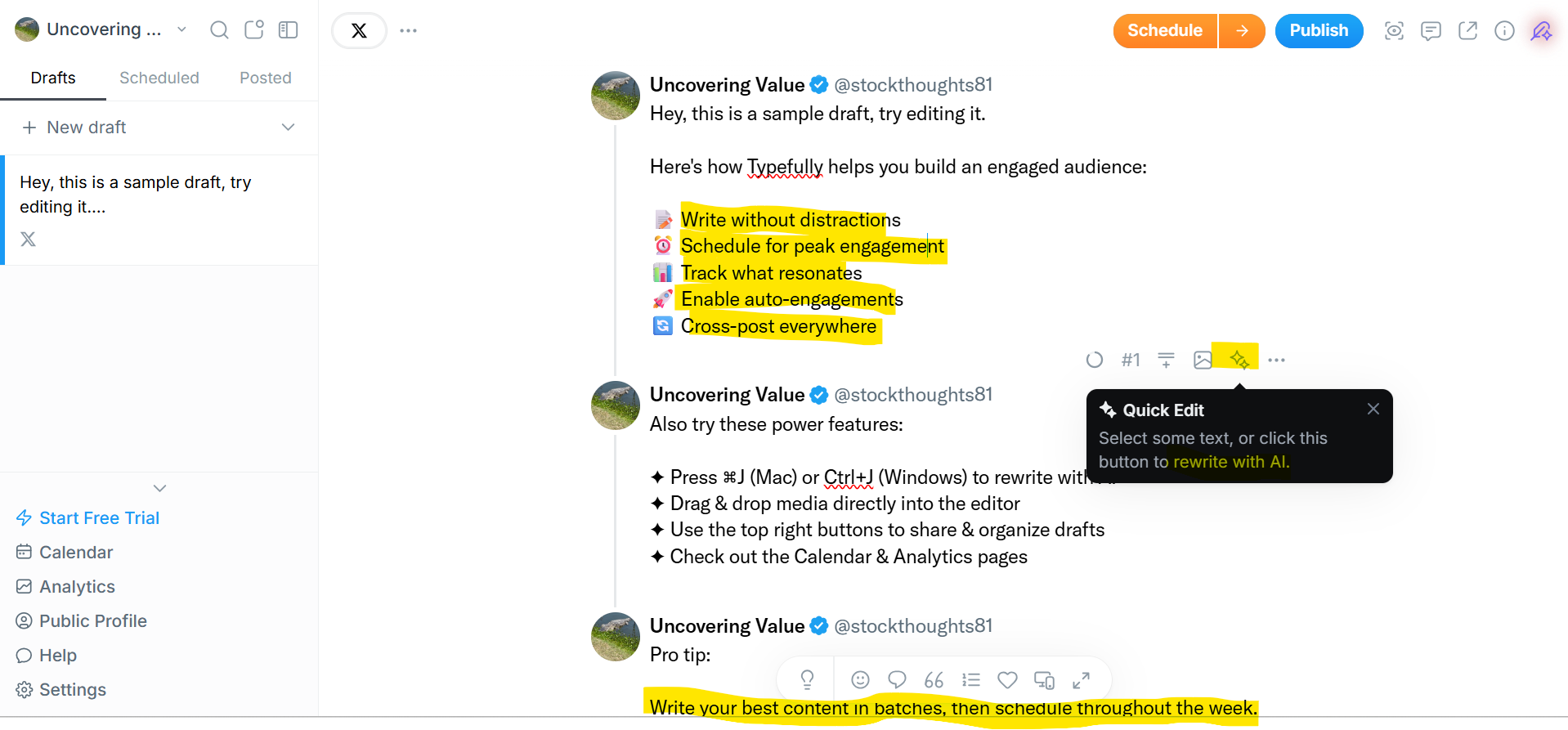
Side note: I just signed up for Typefully while writing this. Two observations:
First, it looks nice. Clean interface, no clutter.
Second, look at what they’re highlighting:
Write without distractions
Schedule for peak engagement
Track what resonates
Cross-post everywhere
These aren’t just Typefully features - they’re the benefits of taking a systematized approach to posting in general. The tool just makes them easier to capture.
What I’m watching:
Does this actually improve consistency, or do I just procrastinate the batch instead?
Does having distance from the post before it goes out improve quality?
Does this reduce the friction enough to matter?
This post is rep 1. I’m using the system to distribute this very article/the associated short-form posts. I’ll report back on how it goes.
Why I’m sharing this
I’m working on helping people build their online presence, and I think that means I should be constantly running small experiments like this on my own process. Each one is small. Each one might teach me something I can pass on.
I’m not writing this as someone who has the answer. This is me trying to move my process in a better direction, and I’m curious if this one sticks.
PS: If you’re someone with real expertise in your field who’s been meaning to start posting online but keeps putting it off, I’m building something for you. Reply to this email, DM me, or book [here: https://calendly.com/stockthoughts81/new-meeting] -I’d love to hear what’s in the way. I’m equally interested in speaking with people on the other side of this journey - who have used social media to find clients, connections, or opportunities.