

I’m long in-person relationships in the world of AI. I believe that where you are matters. Lago Vista isn’t Austin if you can only make the Austin events once a week. Moving to south Austin has opened up a whole world of deep tech / hard tech. I went to a bonfire last week. A bonfire in Austin? Hell yeah dude. There were people there building autonomous boats for the U.S. military. I couldn’t be more here for this.
What even is it, and what do we call it?
Deep tech? Hard tech? Critical tech?
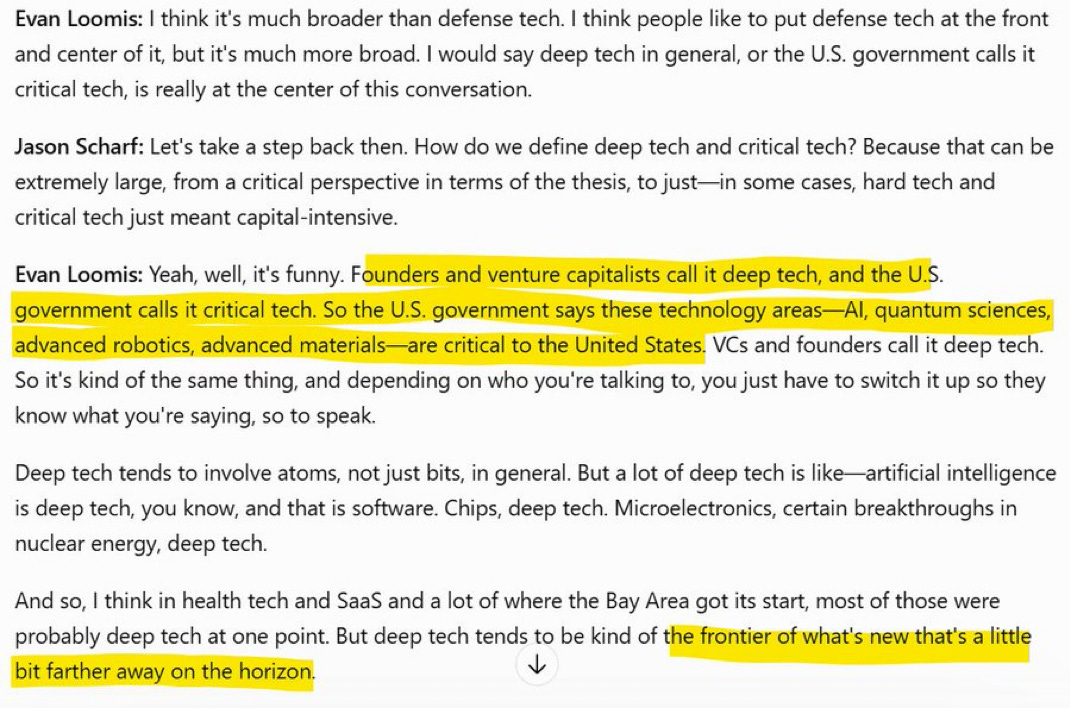
People use these terms pretty loosely. Deep tech usually means there’s a scientific or engineering breakthrough at the heart of the business. The U.S. government has a related category called critical and emerging technologies. These things really matter. Missiles and brain implants, stuff like that.
But let’s get into it. Because the name matters and it means something. Let’s start with hard tech. Hard tech like hardware? Yeah sure. But more importantly this is just hard as in difficult. Maybe you invest millions of dollars in trying to see if the technology even works, if your idea can even exist or function.
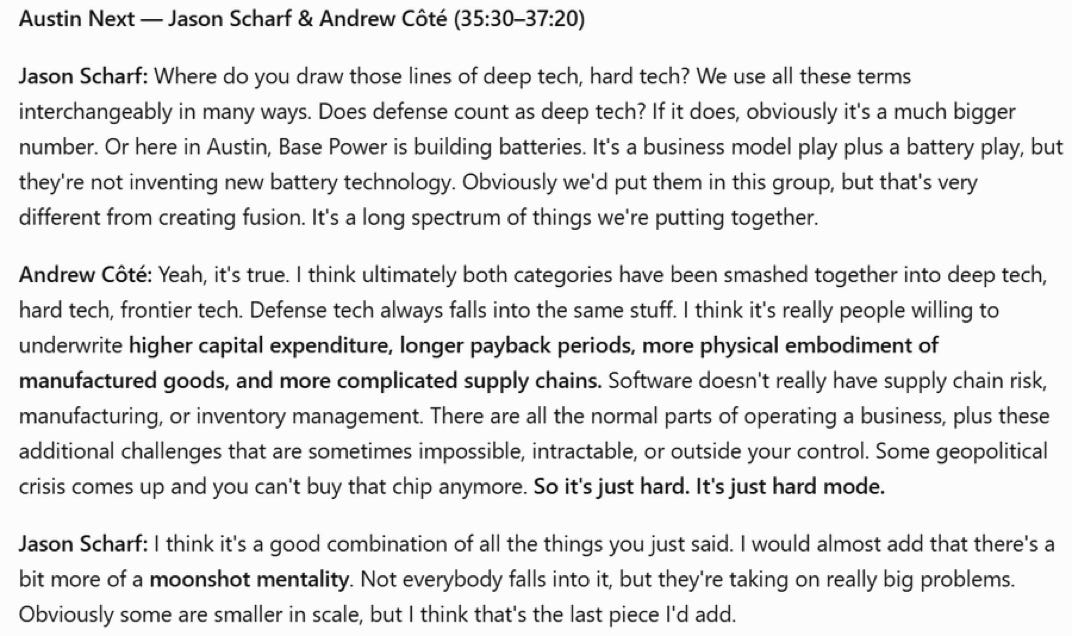
So the main points? These businesses are working on things like defense, electric power, experimental brain implants that help people with paralysis speak. They can require a ton of capex. And possibly for a long time. You can get a SaaS prototype up quickly now. Some of this stuff can take years just to prove out. And I’m not sure AI changes it much beyond being able to try more things faster. Here are a couple of useful explanations from Austin Next:
From Jason Scharf’s conversation with Andrew Côté :
From Jason Scharf’s conversation with Evan Loomis:
This obviously includes a lot of different industries. I’ll refer you to the recent Austin Deep Tech 50 list to get a better idea, but think energy, robotics, manufacturing, maritime, biotech, compute, and defense.
TRL
The whole ‘does this work’ stage is so fundamental that there’s a framework for tracking it. Technology Readiness Levels, of which there are nine. If you’re at TRL 1, you need scientists and engineers in the room figuring out whether the thing is possible. Commercial and financial evaluation probably becomes more relevant around TRL 8-9, when the system has been qualified or proven in actual use.
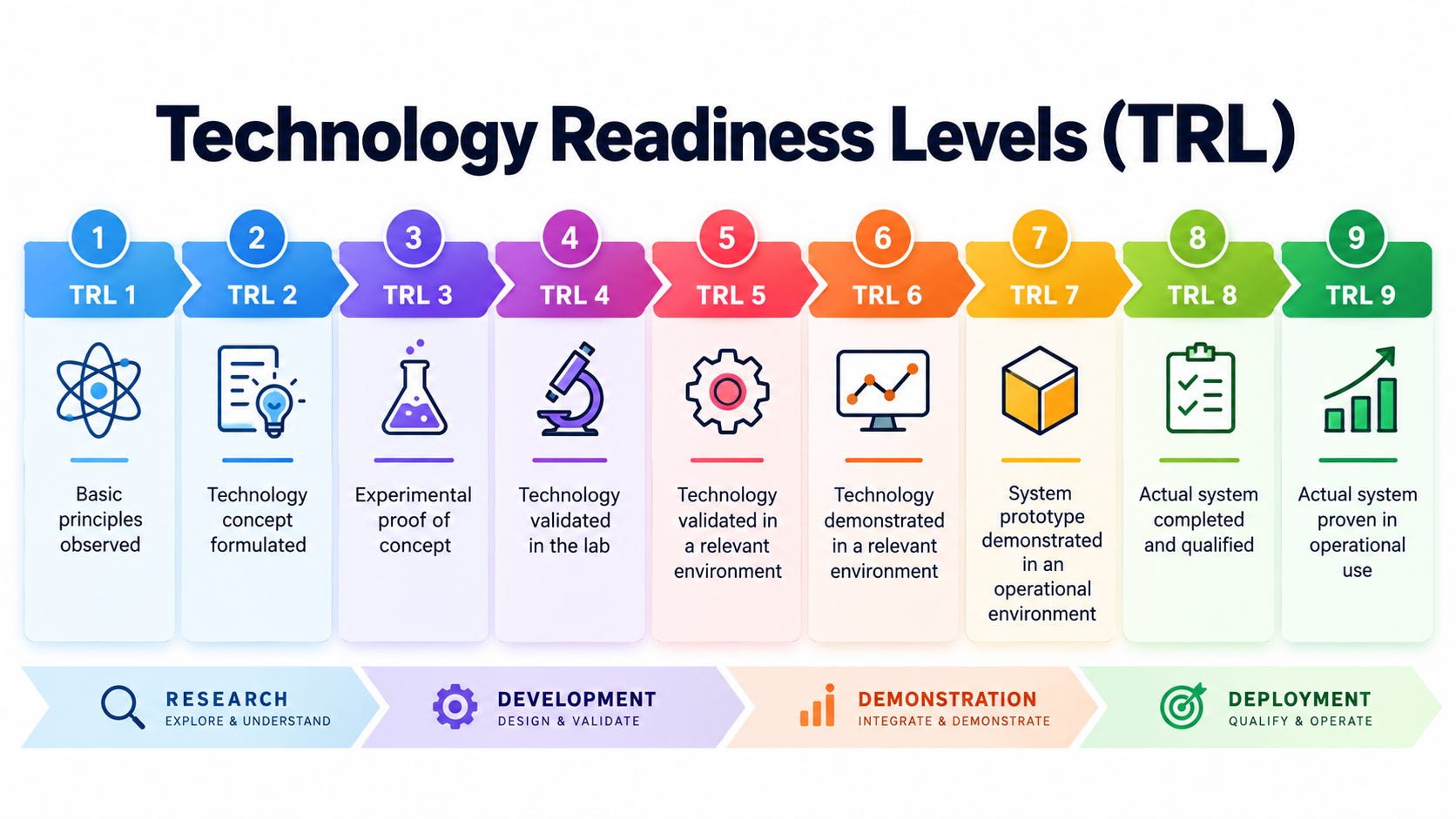
In traditional SaaS, as an example, I’m more used to asking whether people want the product than whether the underlying technology is possible.
I’m still not sure how to articulate where AI fits in this. It does involve GPUs and data centers and dirt and fiber and transmission infrastructure. But AI seems to get talked about as a category of its own now. The frontier research and the infrastructure seem to fit here; an app built on an existing model is a different proposition. I don’t know enough about how AI research is actually done to say how its technical risk compares to the rest of the space broadly.
But as far as the capex goes - yeah, definitely qualifies:


What’s going on in Austin?
I’ll refer you to the Austin Next podcast by Jason Scharf, which has been a huge help in getting up to speed on the local community.
But why Austin? Why are people building autonomous boats, batteries, robots, and all sorts of other complicated things here?
Some of the answers are pretty straightforward. Texas has land (sorry, no Gigafactories downtown), relatively business-friendly regulations, and a growing pool of engineering talent. UT Austin is a major research university. There’s already a substantial manufacturing and semiconductor presence in the region, along with companies like Tesla, Dell, and Samsung. And hard tech benefits from having people nearby who know how to actually build things, not just write software.
There’s also something to be said for proximity. Founders, engineers, investors, and potential employees need to find each other. Having a bunch of ambitious people working on difficult problems in the same place makes that easier. That was part of the appeal of moving closer to Austin for me. You can read about a company on the internet, or you can meet someone who works there at an event.
But perhaps most importantly, though also most squishy - vibes.
Former Austin Mayor Steve Adler used to tell other mayors that the secret to Austin’s success was breakfast tacos and music. He said it jokingly, but insisted it was a serious answer. Companies come because the people they want to hire want to live here.
I think there’s something to that. The tacos. The music. The bars. The weather. A place you actually want to live while you spend years building something hard.
It’s difficult to quantify, and I’m not sure how much of Austin’s success can really be attributed to it versus the more obvious economic advantages. But I suspect the two reinforce each other. Talented people move somewhere they want to live, companies follow the talent, and eventually the companies themselves become a reason to move there.
I’d like to ask a bunch of builders about it. Why Austin? Why this company? Why this problem? I want to hear what more people have to say about it.
What companies to follow
I’ve written a little bit about Starlink unit economics, but am curious to better understand the valuation of SpaceX from a long-term, fundamental perspective if anyone has views on that.
I want to learn more about the defense tech space. Anduril and Saronic seem super interesting to me. Both from a mission perspective but also a circle of competence perspective. Neuralink is cool, but I don’t know enough about how that’s panning out to have a useful opinion. Maybe that’s my concentrated, long-only public equity lens muddying the water though.
Another good one to dig into from both a mission and a financial perspective is Base Power. One number that keeps coming up in Texas electricity is the 474 GW of large-load connection requests ERCOT was tracking as of June 2026, versus a peak demand record of about 91 GW this summer. Of course, a lot of those projects will never get built. But it’s still a pretty remarkable number. We’re going to have to find ways to get more out of the grid. One thing that can help - turning people’s homes into a distributed battery network.
Base Power installs residential batteries that provide backup when power goes out. The rest of the time, Base charges them when electricity is cheap and sells power back to the grid when prices are high.
It was founded by Zach Dell, the son of Michael Dell, and Justin Lopas. Dell used to work at Blackstone and had a great episode on Invest Like the Best in July 2025. So much for startups and VCs not caring about margins - his deep dive on the unit economics was more than you get from most public companies.
Basically how the math worked in that interview - about $10k to get a battery installed, including the hardware, installation, and customer acquisition. The customer pays $500 upfront, and an assumed 30% investment tax credit gets Base another $3k. So call it $6,500 of unlevered cost. Base can monetize the tax credits through outside investors, while the longer-term financing opportunity is to borrow against the batteries' future cash flows.
On the income side, there’s about $200 a year from the monthly membership fee and another $200 in gross margin from selling electricity to the homeowner. But most of the contribution comes from wholesale electricity trading - charging when power is cheap and selling when it’s expensive.
Dell modeled $1,200 a year in trading income, based on a ten-year average of $40 per kWh of battery capacity annually on a 30 kWh battery. Add it all up and you get $1,600 in annual contribution on $6,500 of upfront cost. That’s a four-ish-year simple, unlevered payback on an asset he expects to last 10–15 years.
And the goal is to improve that math by bringing more of the battery design and manufacturing in-house. Dell laid out a path from $10k installed cost to $8k with the second generation and potentially $6k with the third, bringing the modeled payback down to roughly two to three years.
The big question, at least to me, is the trading income. Dell described just how volatile it can be - $100/kWh in a good year versus $20 in a bad one. His modeled ten-year average was $40. That’s three-quarters of the annual contribution in the example, and it’s the assumption I’d most like to understand. ERCOT battery trading revenues have fallen sharply in recent years as more batteries compete for the same opportunities. Power-price volatility is part of the opportunity (reminds me of fuel margins at gas stations), but it also makes the returns harder to predict. I may dig into that in a subsequent article.
If you follow anything to do with this space, let’s talk.
Disclosure: none of this is investment advice; I/we may have positions in securities mentioned.