

The Numbers
AWS Is Going Insane
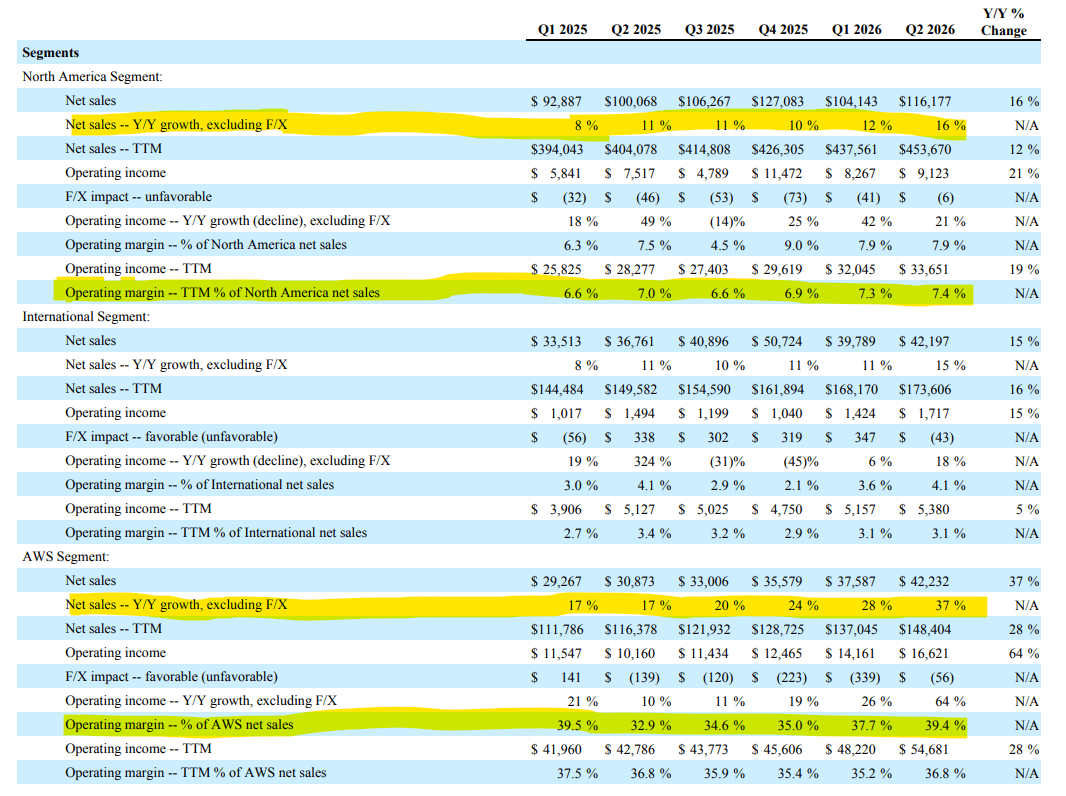
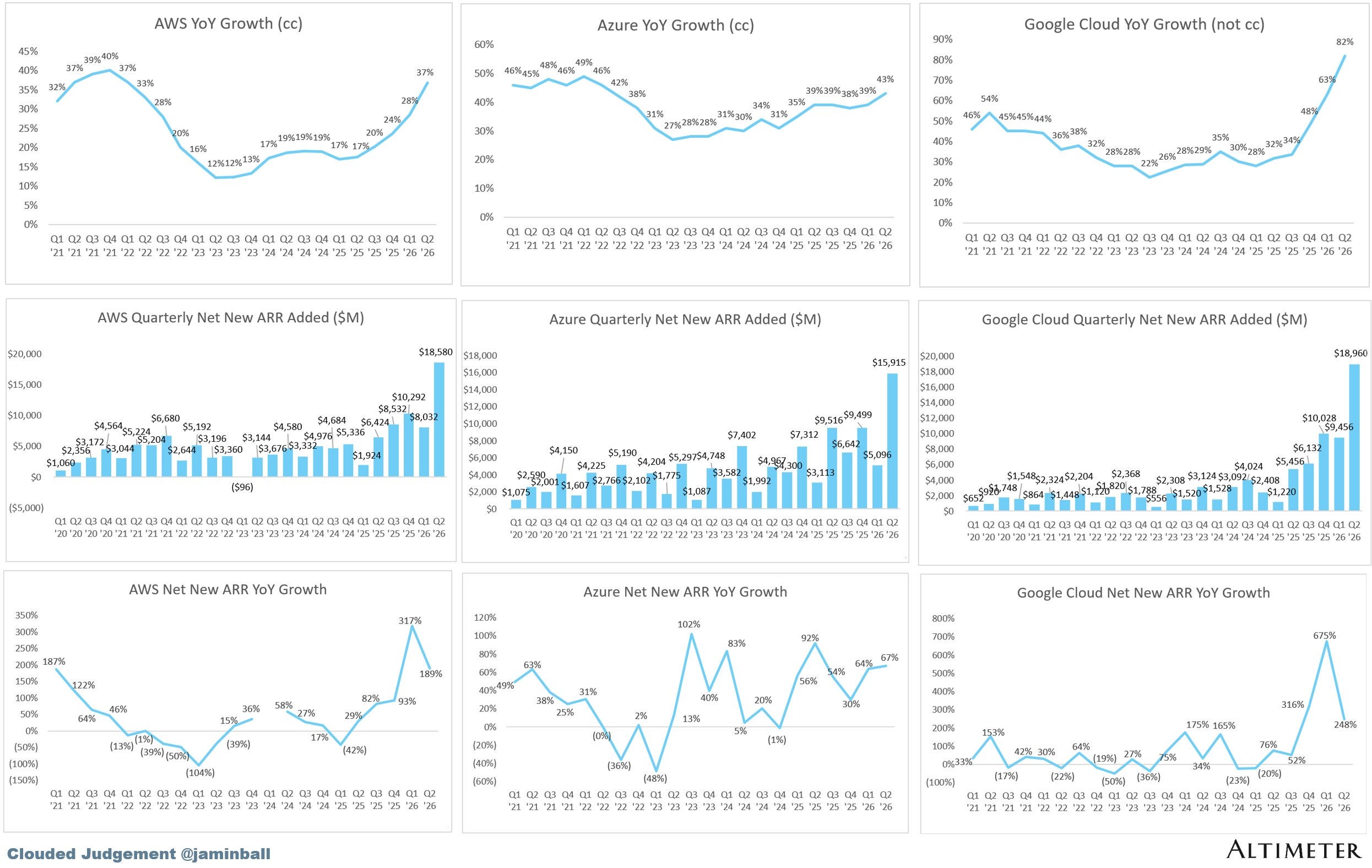
AWS growth accelerated from 28% to 37% in the quarter, at a $169b revenue run-rate. This would place it 24th on the F500 list if it was standalone.
This excellent visual from Jamin Ball of Altimeter shows how the growth compares to peers:
Backlog has reached $496b and is growing triple digits. AI revenue run rate as well as the chips business (Trainium, Inferentia, and Graviton for CPUs) each exceeded $25b and are also growing triple digits. AI applications have helped drive growth in core demand as well through post-training reinforcement learning, agent tool use, storage, databases, etc.
AI at Amazon includes a number of things worth noting. Perhaps the most consequential is Amazon Bedrock, an inference platform that provides a single unified API to build GenAI apps using any of the top foundation models. Third parties estimate that it was 1/3 of the $15b AI business disclosed in 1Q. Hundreds of thousands of customers are now using it, with more customers being added in the past six months vs the first two years after launch (Sept 2023). Demonstrating the exponential nature of AI growth that other leaders are experiencing, they reported more spend on Bedrock in 2Q than all prior quarters combined.
Other areas of note on the AI front:
SageMaker AI - helps companies build their own foundation models, integrating proprietary data.
Bedrock AgentCore - makes it easier to work with agents in production by handling all the “muck” (security, memory, identity, integration of tools and data, etc.).
Kiro - coding agent. Usage tripled QoQ and management claims it is 50% more cost-effective than alternatives (relevant amid the tokenmaxing noise).
Amazon Quick - AI work companions. I think these will be huge. Meta talked a lot on their call about business agents, which sound like messaging assistants that integrate with CRMs and other systems for SMBs on META’s platforms. While that’s an interesting opportunity, I believe knowledge workers are likely to be a vast market as well. Zuckerberg used to talk about VR applications in business and that he thought some sort of VR system would eventually be widespread among white collar work. Well, I’m not sure headsets were the right form factor for that, but this is probably it. I’ve been running my work life through Claude Code/Codex for several months now and cannot imagine going back. This is an out-of-the-box solution that does the same. I know from experience that it takes a lot of tinkering to get it to work, and Zuck mentioned that engineers’ willingness to tinker is part of the reason the agentic adoption has happened in coding so much faster than anywhere else. That’s about to change. Current Quick customers include 3M, Autodesk, BMW, Exxon, FINRA, Intuit, Mondelez, Moody’s, the NBA, the NFL, and Southwest Airlines. Jassy noted the product actually grew out of just having so many people within Amazon that wanted an intelligent AI assistant (remind you of anything?).
Continuum - discovering and dealing with code vulnerabilities
Frontier model - while Jassy noted they could be successful without one, they are working on one. They want control over cost, priorities, and speed. His view is that “within the next few years, you're going to have at least a half dozen models that are comparably good to each other. They'll all be in Bedrock, and one of them will be ours.”
The chip business is becoming more prevalent as well. Anthropic and OpenAI have made multi-year, multi-gigawatt Trainium commitments. Jassy also said Amazon is exploring selling Trainium chips separately from AWS. 98% of Amazon’s top 1,000 EC2 customers use Graviton, with revenue commitments rising nearly 3x QoQ.
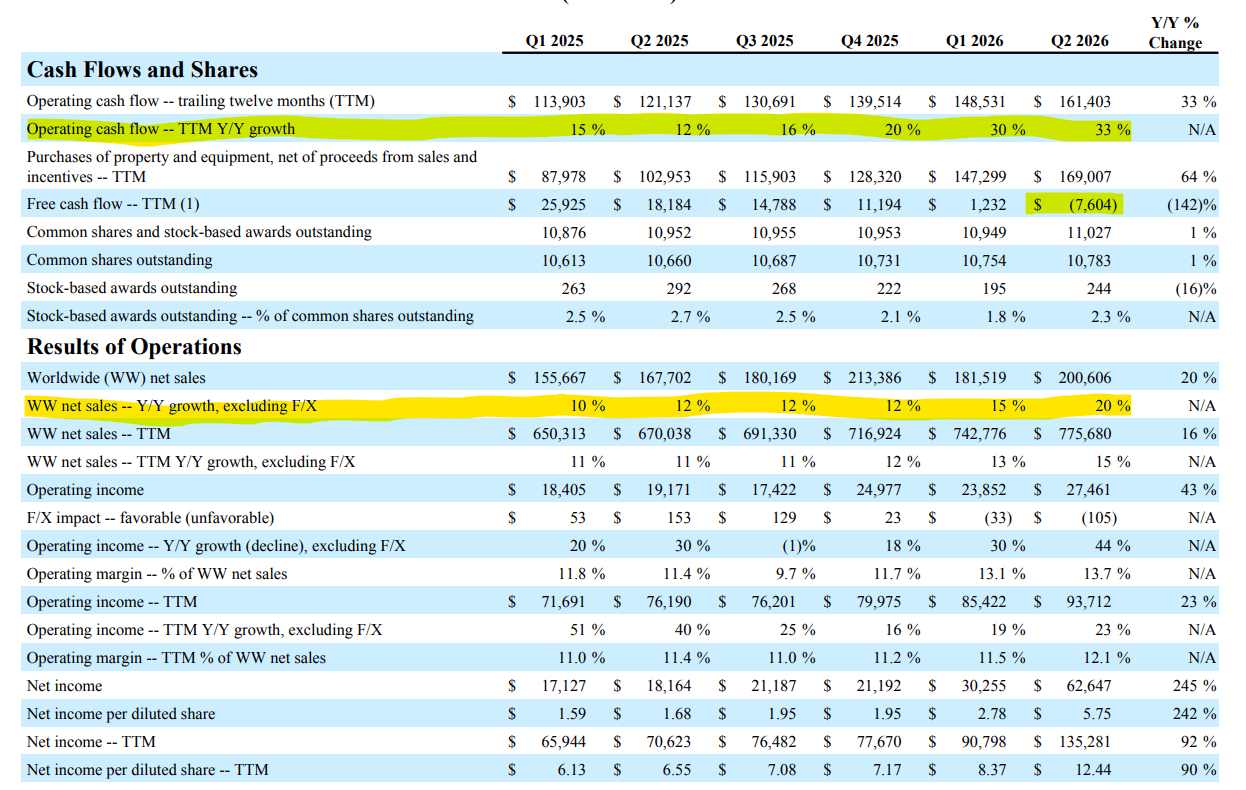
And, last but not least, all this is happening with margins expanding 650bps yoy (520bps ex the energy-derivative gain) to 39%.
Talk about firing on all cylinders.
The Debate: Capex and FCF
Amazon’s reported TTM free cash flow is now negative. The company generated $161.4 billion of operating cash flow and spent $169.0 billion on property and equipment, net of asset-sale proceeds and vendor incentives, leaving negative $7.6 billion of reported FCF. That is a meaningful change from the $18.2 billion of positive TTM FCF it reported a year ago.
The easy read is that Amazon is doing what every hyperscaler is doing: converting current cash flow into an enormous AI buildout and asking investors to trust that the returns will arrive later. There is some truth to that. Amazon has raised its 2026 cash-capex plan from roughly $200 billion to roughly $220 billion, citing higher memory costs, and management says the majority supports AI and AWS. The company does not separately disclose the return on that spend, the duration of its backlog, or the detailed terms behind the capacity reservations it keeps discussing.
But the call offered a more useful way to think about the risk than simply putting the $220 billion next to the negative FCF number. Jassy separated the investment into two capital cycles. Data centers have to be built roughly two years before servers can be plugged in and revenue starts. That is the long-dated, front-loaded bet. Once built, however, management describes those facilities as assets it can monetize for 30-plus years, across multiple generations of equipment. Servers and networking gear are different: Amazon says it typically buys them only months before placing them in service, when it has better visibility into demand. Jassy put the average break-even at a little under three years and the useful life at at least five to six years.
That does not make the spend riskless. If AI demand fell sharply, Amazon could still be left with an expensive cycle of servers and networking gear, and AWS margins will not simply stay at 39% by declaration. Management itself says margins will fluctuate with investment levels and the AI/non-AI mix.
Still, the demand evidence makes this debate look different from a pure speculative capacity build. AWS grew 37% in the quarter, and management reported a $496 billion backlog growing at a triple-digit rate. Jassy said Amazon will not have enough capacity to meet all demand in 2026, expects the same in 2027, says the lion’s share of incremental 2027 capacity is already reserved, and says quite a bit of 2028 capacity is reserved. This helps explain why Amazon is willing to build data centers ahead of monetization rather than merely add a quarter’s worth of servers at a time.
The longer-term argument is even more important to the data-center piece. Jassy’s view is that 85% of global IT spend still sits on premises and that the on-prem/cloud balance will flip over the next 10 to 20 years. He now thinks AWS could eventually become a $1 trillion annual-revenue business. That is not a near-term forecast, and it should not be used to hand-wave away all risk. But it does speak directly to another question investors should ask: if the immediate AI adoption curve gets uneven, is there enough broader cloud migration and enterprise demand to fill a 30-year infrastructure asset over time?
What I find encouraging is that Amazon is not merely asking investors to accept a future return on the infrastructure it is building now. The existing AWS asset base is already producing 37% growth at a very high operating margin. That does not tell us exactly which vintage of capacity earned what return, and it does not eliminate the risk of an AI demand slowdown. But it is evidence that Amazon knows how to turn data-center spend into a valuable compute business. The current build is also not just raw capacity: AWS sells the infrastructure directly, has contracts and reservations against part of it, and is layering Bedrock, agents, and custom silicon on top. If the near-term AI curve gets choppy, the server cycle is still exposed. The longer-lived data-center footprint has a broader base of cloud demand behind it.
Retail Update (how do you compete with this?)
Retail continues to perform well, too. And the network is becoming faster, denser, and more useful for higher-frequency categories such as grocery. Some of the highlights:
N America sales of $116b up 16% yoy. EBIT of $9b up 21% yoy (7.9% margin).
Intl sales of $42b up 15% yoy. EBIT of $1.7b up 15% (4.1% margin).
Delivery, fulfillment, cost to serve
Global same-day/overnight items +40% in 1H
Same-day selection up to 40x greater than a typical big-box retail store
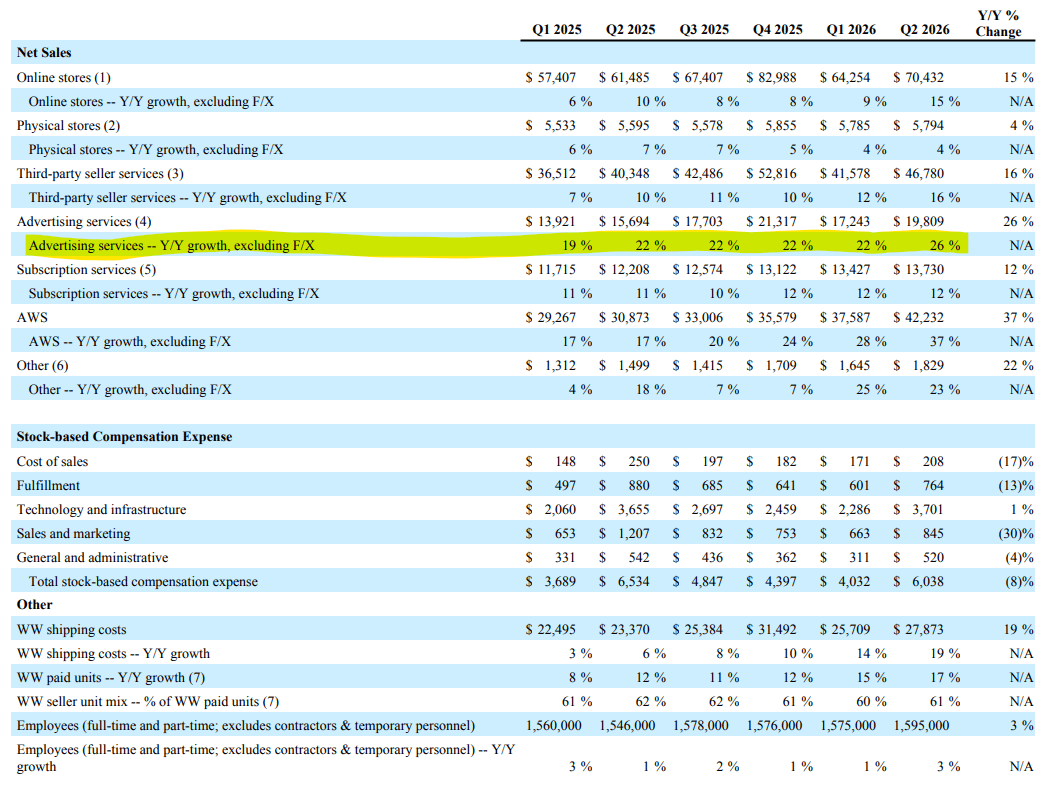
Shipping costs +19% yoy vs paid-unit growth of 17%. Excluding higher fuel and line-haul rates, units grew faster.
Prices on average 14% below other retailers (Profitero)
Grocery
Second largest grocery in the US ($150b+ last year)
+50% monthly active perishable customers since Jan
Same-day orders containing perishables averaged more than 3x as many units per order
Fresh groceries represent 6 out of Amazon’s 20 best sellers
In regions with same-day perishables (2,300 US cities), 9 of top 10
Amazon Haul - I am surprised this isn’t talked about more as a DG/DLTR competitor, especially given AMZN’s rural logistics investments over the last couple of years and already strong urban network
Expanded selection nearly 20x since launch, now 6m items priced below $10
Amazon Is Eating The World
Amazon jumps from industry to industry ruthlessly applying their customer-obsession playbook. It’s hard to find a business that they aren’t impacting in some way. And once their customers ask them to start competing in a new area, they will.
Consider this a bit of a catch-all section:
Advertising
Grew 26% yoy to $20b, up from the 22% rate that had held steady for the prior four quarters.
Sponsored Products remains the largest offering
Agentic/conversational experiences (Alexa+, Alexa for Shopping) - shoppers who click a sponsored prompt convert 48% more often and spend 21% more
Amazon Business
$60b annualized gross sales
Selection up 30% yoy
Pharmacy
New customers more than doubled yoy in 1H
Same-day prescription deliveries up 5x
Saved customers $250m in out-of-pocket costs, up 400%
Supply chain
Launched Amazon Supply Chain Services for businesses to move, store, and deliver raw materials through finished goods on the Amazon supply chain.
Customers include P&G, 3M, and American Eagle.
~400 Leo satellites in orbit
That’s the quarter, watching for more data to inform on capex ROI from here.
Further Notes
This post by Gavin Baker argues that hyperscalers are underearning because spot prices for GPU compute are currently higher than contracted rates (link)
“Consensus estimates are probably for 25-35 gigawatts added by hyperscale and neoclouds in CY28 (using a range as standing up datacenters is hard and a lot of the neos plus labs are still private). At 60b per gigawatt, that is 1.5 to 2.2 trillion in capex. Consensus estimates for hyperscale/neo operating cash flow is 1.3 to 1.4 trillion. I think this gets revised up materially as contracts reprice and growth accelerates so the 100b to 700b that would hypothetically need to be plugged by debt goes away.”
Meta, in their discussion about possibly renting out compute to third parties, corroborated that current rates are much higher than what they acquired it for. They are getting offers at “multiples” of what they paid for it.
An interesting analysis of the ROIC case for AMZN based on the disclosures provided on the call (link)
My main question here would be the jump from 22% to 29% from managed services/PaaS on top - is that not included in Jassy’s initial server payback?
One complicating factor in reading into the AWS margin increase is that much of the D&A hasn’t flown through yet.
A discussion about bargaining power between hyperscalers and AI labs (link)
“While AWS has the title of being Anthropics “primary cloud provider,” ie where it runs its internal cloud environment, databases, storage, etc, GCP actually serves more GW of DC capacity to Anthropic as its primary training partner and major inference partner (per SemiAnalysis).”
MBI’s response to the Southern Value tweet above (link)
“If lab revenue disappoints, Google can slow capex and absorb capacity into its massive 1P workloads i.e. Search, YouTube, Gemini, DeepMind can all soak up TPUs.”
I think this apply to Meta too with their ads business.
I am not sure if it applies to AWS via the 85/15 IT spend flip - it’s not internal, the demand may not require the same type of compute, and the timeframe is probably longer.
“The possibility of insourcing IS labs’ bargaining power. Once a lab matures to build its own capacity, it will know its all-in self-build cost per token with precision. That number then becomes the ceiling on what it will pay any landlord, plus perhaps a convenience premium for speed, and flexibility.”
Disclosure: this is not investment advice and I/we may own positions in securities mentioned.